What happens to your blood tests at menopause: a study of a million women
Researchers looked at more than 300 million lab tests from over a million women and found that many values shift in a sudden step around menopause. A calm look at the new Nature Medicine study and what you can take onto your plate right now.
Many women after 45 tell me the same thing: "I haven't changed anything, and suddenly my blood tests look different." Cholesterol is higher than last year. The doctor mentions bone density. Liver enzymes sit at the top of the normal range. And it feels as if it all happened within a single year.
A large new study shows there are real numbers behind that feeling.
What the researchers did 🔬
A team at the Weizmann Institute of Science in Israel (led by Glen Pridham) brought together lab data from more than a million women in two large databases, one in the United States and one in Israel. That adds up to over 300 million lab tests of 90 different kinds, from cholesterol and liver tests to kidney markers and hormones. The paper was published in Nature Medicine on 12 October 2026.
The hard part of such studies is that age and menopause travel together. A woman is 51 and her cholesterol has gone up. Is that age, or menopause? The researchers built a model that separates the two: calendar age on one track, the "reproductive clock" on the other.
What they found 📊
The usual assumption is that the body adjusts to menopause gradually, year by year. The data showed something else. Around the final menstrual period, many values make a step-like jump.
- In the US data, 52 of 90 lab tests changed abruptly.
- The biggest shifts were in three systems: bone metabolism, liver tests and blood lipids (the "fats in the blood": cholesterol and triglycerides).
- There were also clear changes in kidney function, general blood chemistry and, of course, sex hormones.
- Men show no such jump. That is why the authors link it to menopause itself. Ordinary ageing does not explain it.
One more detail that few people know: hormones start changing long before the last period. According to the study, AMH (anti-Müllerian hormone, a marker of egg reserve) begins to fall about 15 years before it, FSH begins to rise about 14 years before, and oestradiol begins to fall about 12 years before. For many women, the transition is already under way in their late thirties.
No need to be frightened 🕊️
I want to say this clearly. The study is observational: it shows how lab values change, and it does not prove that health or wellbeing must get worse because of it.
The independent experts who commented on the paper say the same. Professor Martha Hickey of the University of Melbourne finds the word "cliff", which has appeared in headlines, alarming and inaccurate: the study does not show a dramatic decline in how women feel. Professor Andrew Shelling of the University of Auckland calls the results interesting but not yet conclusive.
What it does give us is time. Hormones start shifting years before the jump, and those years are enough to build habits calmly.
What I take from it for myself 💚
I'm 48, and my conclusion is simple: it's worth thinking about bones, the liver and blood fats before menopause, from around 40. The habits we build now keep working once the hormones change.
Here is what that looks like on the plate.
🥩 1\. Protein at every meal
Muscles and bones are more closely linked than it seems. Many researchers suggest that women over 40 aim for about 1–1.2 g of protein per kilogram of body weight a day. At 60 kg that is roughly 60–72 g. It's easiest to split it over three meals of 20–30 g: eggs or cottage cheese in the morning, fish or legumes at lunch, lentils or chicken in the evening.
More on how much protein you need, and when it can be too much: Protein without extremes.
🦴 2\. Calcium and vitamin D from food
After menopause, bones lose density faster, and the new study confirms it: bone metabolism was among the most visible jumps. Many guidelines for women over 50 name about 1,000–1,200 mg of calcium a day.
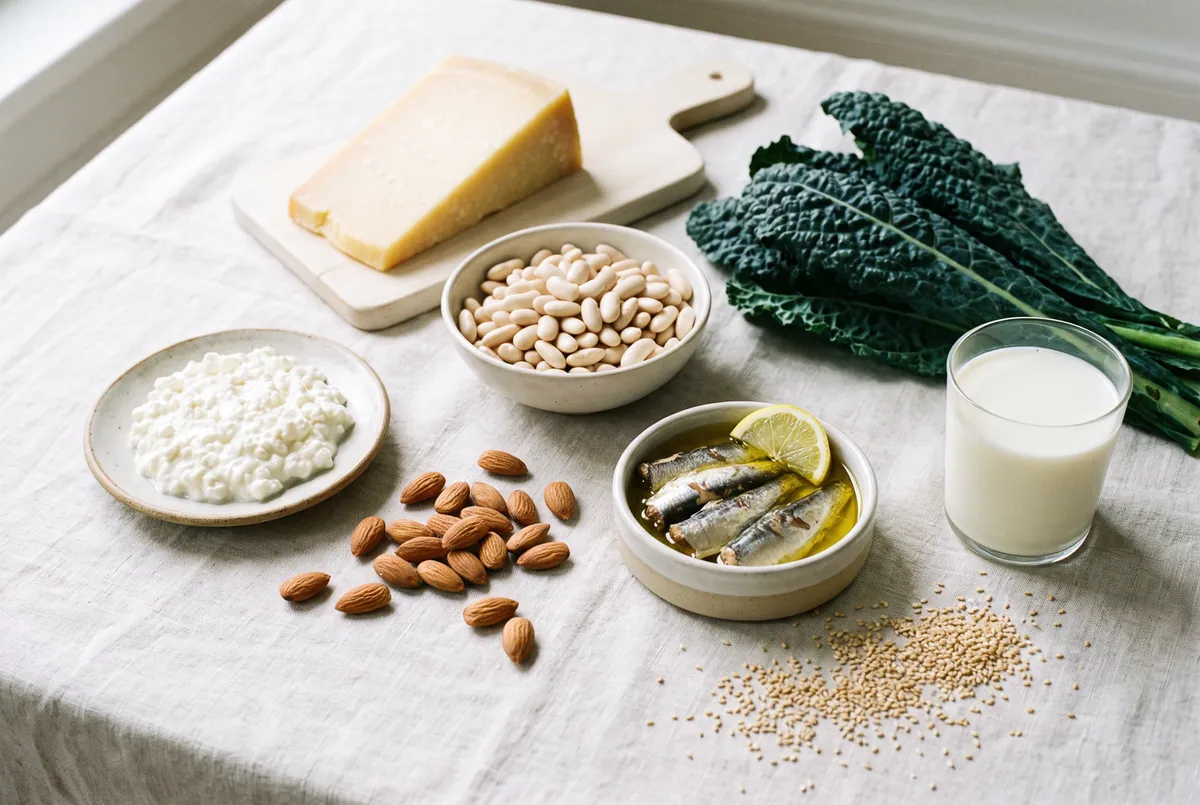
Where to find it without supplements:
- cottage cheese, yoghurt, kefir, hard cheese;
- sardines and salmon with their soft bones;
- white beans, chickpeas;
- almonds, sesame, tahini;
- dark greens: kale, broccoli, bok choy.
Food contains little vitamin D: oily fish, eggs, a few mushrooms. Have your level checked and discuss with your doctor whether you need a supplement.
🫒 3\. Fats that help your lipids
Cholesterol and triglycerides often rise after menopause even when the diet stays the same. Two things help here:
- soluble fibre: oats, barley, legumes, apples. Aim for 25–30 g of fibre a day. I explain how to get there without counting in my article on fibre;
- healthy fats in place of some of the butter and processed meat: olive oil, nuts, seeds, avocado, oily fish twice a week.
🥦 4\. Your liver likes simple things
Liver tests were among the values that jumped, too. The liver is helped by very ordinary things: fewer sugary drinks and less alcohol, more vegetables and fibre, movement every day.
🏋️♀️ 5\. Strength training
This isn't about the plate any more, but for bones it matters a lot. The WHO recommends muscle-strengthening exercise at least twice a week for adults. It's one of the strongest signals for bone: the muscle pulls on the bone, and the bone gets stronger. You can start at home with your own body weight.
How this fits TheBetterPlate 🍽️
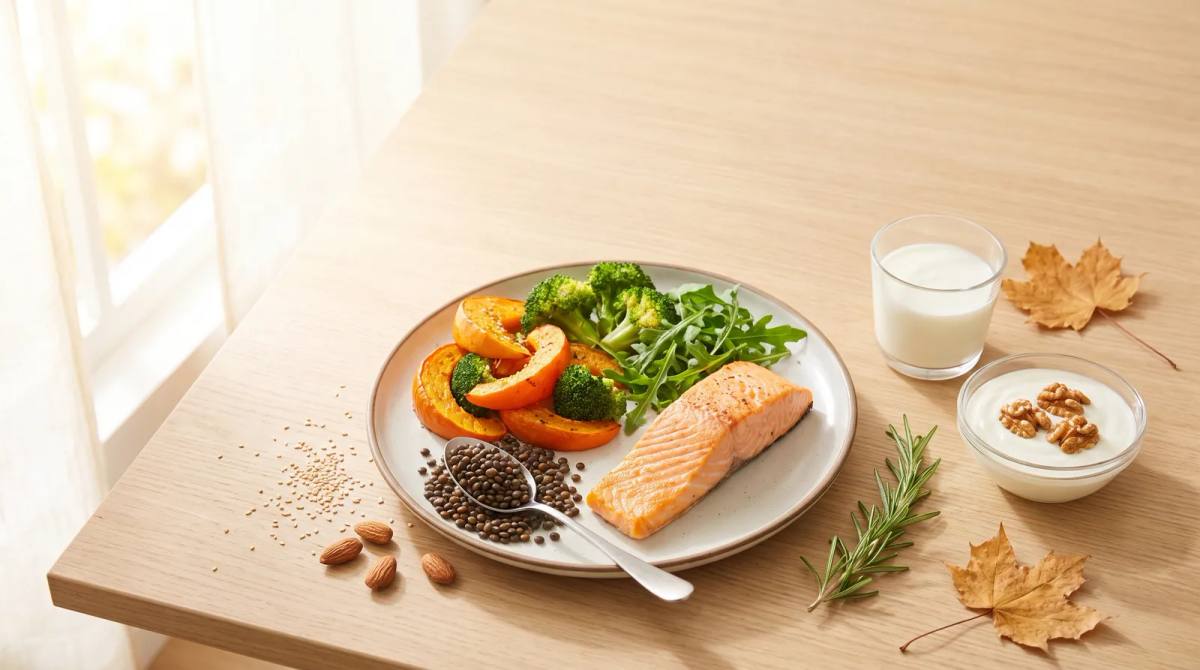
My method, TheBetterPlate, rests on a simple layout: half the plate vegetables and greens, a quarter protein, a quarter slow carbohydrates, plus a spoonful of healthy fat. Seen through the lens of this study, it covers almost everything at once: protein for muscles and bones, fibre and good fats for lipids, vegetables for the liver.
You can try a day like this for free: three recipes with exact amounts are on the trial day page.
Start with one step this week ✅
- Add protein to breakfast: two eggs, cottage cheese or yoghurt.
- Put one handful of legumes or dark greens on your plate each day.
- Book a blood test and ask your doctor what makes sense to check at your age: lipid profile, glucose, liver tests, vitamin D, ferritin, thyroid hormones. Your doctor will tell you whether you need a bone density scan.
- Find 20 minutes twice a week for strength exercises.
Start with one item; you can add the rest later 🌱
Frequently asked questions
Does this mean my health will get worse after menopause? No. The study shows changes in lab values, not in how women feel. The experts stress that it does not show a dramatic decline.
From what age should I pay attention? Hormones start changing 12–15 years before the last period, so for many women from 35–40. The earlier the habits are in place, the calmer the transition.
Which tests should I discuss with my doctor? Most often: lipid profile, glucose or HbA1c, liver tests, vitamin D, ferritin and thyroid hormones. Which of them you need is your doctor's decision.
Can I get enough calcium without supplements? Many women can: dairy, fish with soft bones, legumes, nuts and greens give a good base. If you eat little dairy or are unsure, ask your doctor.
Does the study also apply to women whose menopause followed surgery? The summary I read does not look at that case separately. That's a question for your gynaecologist.
Would you like to see what a day of TheBetterPlate looks like? Open the free trial day with three recipes. And if you'd like to prepare calmly for 40+ as a whole, read my article "Menopause is not a sentence".
Get new Better With Anna articles straight to your inbox.
Source: Pridham G. et al., Nature Medicine, 12 Oct 2026, doi.org/10.1038/s41591-026-04614-0. Figures as reported in ScienceAlert's coverage of the study, 12 Oct 2026.
The information on this site is for educational purposes only and does not replace medical advice. Before changing your diet or starting any health-related programme, consult a professional, especially if you have a chronic condition, are pregnant or breastfeeding, or take medication.