Dairy: what the new science says, how to recognise lactose intolerance, and whether fat-free is worth it
Cheese, kefir, bifidus yogurt, high-protein quark: what the 2026 research shows, how milk entered the human diet at all, how to recognise and test for lactose intolerance, and what to eat instead if dairy doesn't suit you. Calmly, with numbers and without bans.
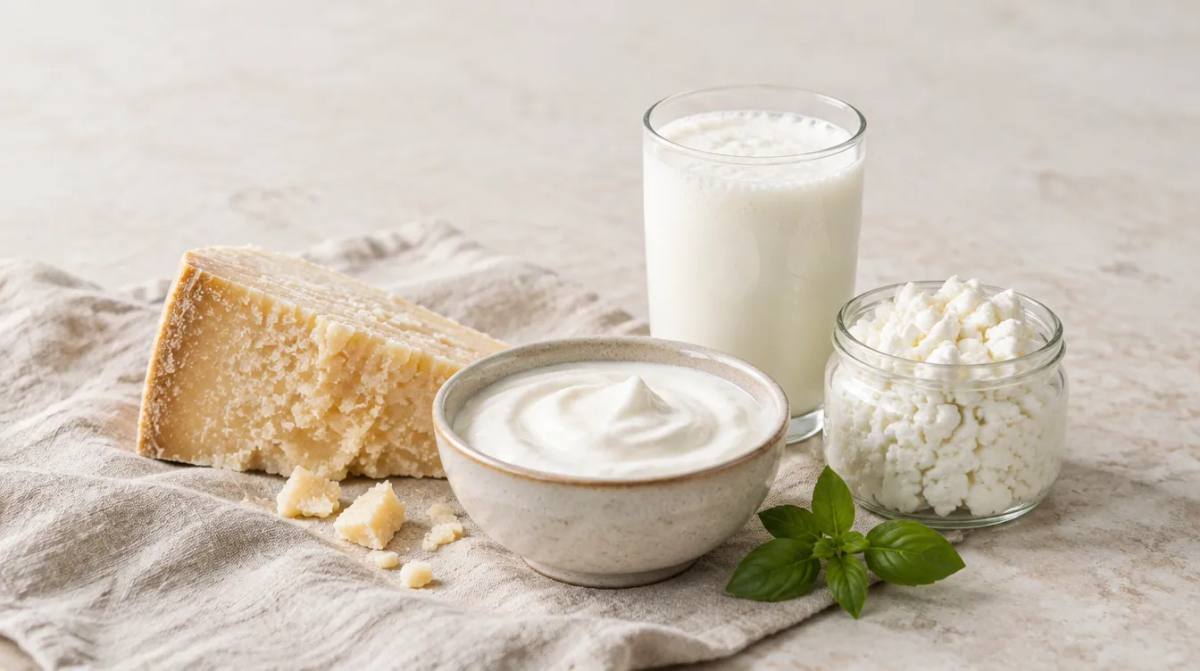
I get asked about dairy all the time, and the questions are nearly always the same. Can I eat cheese every day? Is kefir better than milk? Does milk cause inflammation? My stomach bloats after a cappuccino: is that lactose? Should I buy fat-free yogurt or regular? And what about high-protein?
I understand why there is so much doubt. In recent years dairy has been both banned and rehabilitated, and the supermarket shelf has grown longer than any list of questions. The subject is personal for me: a cheese dairy is part of my story, and I love good cheese. So I sat down and read what the science says now, in 2026. For most people, dairy is far from the worst part of the plate. But different products act differently, and some of them really don't suit some people.

Where milk came from, and whether it is natural
Milk is a fairly recent addition to the human diet. A 2022 paper in Nature examined around 7,000 fat residues on pottery from more than 550 archaeological sites in Europe. Milk was in wide use there from about 7000 BC. Pottery from Poland carries traces that point to cheesemaking about 7,500 years ago.
The genetics are the most interesting part. The ability to digest lactose as an adult was rare at first: its earliest traces in ancient DNA date to about 4700 BC, and it became common in Europe only around 1000 BC. So people ate dairy for thousands of years while hardly carrying this gene. Processing probably helped too, since cheese and cultured milk contain much less lactose than fresh milk.
Is it natural? I don't find "natural" a useful test. Milk is natural for a baby. For an adult it is a cultural invention a few thousand years old, and so are bread and olive oil. A better question is how a given food acts on you.
What the 2026 studies show 🔬
All the studies below are observational. They find associations and don't prove the food is the cause: people who eat yogurt often live differently in other ways too.
- Yogurt and cheese. A meta-analysis in Frontiers in Nutrition pooled 29 studies and nearly 1.7 million people. 200 g of yogurt a day was linked to an 11% lower risk of death from all causes and from cardiovascular disease. 15 g of cheese a day (a thin slice) was linked to 5% lower cardiovascular mortality. For dairy overall the curve was U-shaped, with the lowest risk around 250–300 g a day.
- Fermented foods. Another meta-analysis, of 50 studies and more than 3 million people, showed the same picture for cheese and fermented milks.
- Amount. In the American NHANES data (37,366 adults, Scientific Reports), people who ate fermented dairy had an 18% lower risk of death from all causes. But the link held only up to about 150 g a day, and above that it was no longer statistically significant.
- Cheese and the brain. A Swedish study in Neurology followed 27,670 people for about 25 years. Dementia was 13% less common among people eating 50 g or more of full-fat cheese a day than among those eating under 15 g. No link was found for low-fat cheese, milk or fermented milks. The full-fat cheese eaters in this study were on average better educated and healthier, so cheese can't be called a dementia treatment.
In January 2026 the new American dietary guidelines included whole-fat dairy without added sugar. They kept the saturated fat limit: no more than 10% of daily calories. The fat question is still open, and a controlled trial at Penn State is not due to finish until 2028.
What about bifidus?
I'll be careful here. On a label "bifidus" sounds like medicine, but the effect of bacteria depends on the specific strain, which often isn't on the pack. Controlled studies of fermented milks with bifidobacteria do exist, for example with the strain B. longum BB536, but they look at the gut environment in healthy people. A pilot study of yogurt (with other bacteria) and bone density found no difference between groups. So I treat kefir and live yogurt as good food and don't expect them to act as treatment. There is more on the gut in my microbiome guide.
Lactose intolerance: how many people live with it
Lactose is milk sugar. To absorb it, the gut needs an enzyme called lactase. In most people it declines after childhood, and this isn't considered a disease. A 2026 review estimates this applies to about 70% of adults worldwide, and 50 to 90% in countries of Africa, Asia and South America. It is least common in people of European descent.
You may come across the figure "68%". It comes from a 2017 paper that The Lancet Gastroenterology & Hepatology retracted in 2025 over problems with data selection, so I wouldn't treat it as exact. The new review gives the same order of magnitude.
There is no single figure for Russia. In individual samples, the genetic variant linked to reduced lactase was found in 36% of medical students in the north of the country and in 51% of girls in Samara. Its frequency varies widely by region and is highest in Yakutia.
Reduced lactase doesn't automatically mean symptoms. Many people who have it eat cheese and yogurt without a problem and never suspect a thing.
Where it comes from
- Genetics. The most common cause: lactase production falls on its own, so symptoms can appear in adulthood too.
- Damage to the gut. For example with coeliac disease, Crohn's disease or after treatment. This is secondary intolerance: once the cause is treated, lactose may be absorbed again.
- The congenital form. A very rare condition present from birth.
What it feels like
Undigested lactose reaches the large intestine, where bacteria ferment it. Symptoms usually appear within a few hours of eating dairy:
- bloating and gas;
- abdominal pain and rumbling;
- diarrhoea;
- nausea, sometimes vomiting.
The more lactose at once, the stronger the reaction. That's why a large latte can cause symptoms and a piece of parmesan doesn't.
This is different from an allergy. An allergy is a reaction to milk protein. A rash, swelling or difficulty breathing need a doctor, and you should never "test" such a reaction yourself. Unexplained weight loss, blood in the stool, night-time symptoms or constant diarrhoea shouldn't be put down to lactose either: see a doctor straight away.
How to check
- A diary and a pause. For two weeks, write down what you ate and how you felt. Then leave out milk and soft dairy for a couple of weeks and bring back a glass of milk. If you have a chronic condition, talk to your doctor first. This is a pointer, and it can't give a diagnosis.
- Hydrogen breath test. The main method. You drink a known dose of lactose and blow into a container every half hour while noting symptoms. Current guidelines require both a positive test and typical symptoms for a diagnosis.
- Genetic test. This shows a tendency to reduced lactase. It can't tell you whether you have symptoms and doesn't detect the secondary form, so it doesn't settle the question alone.
If you feel no better without dairy, the cause is probably something else. That is a reason to talk to a gastroenterologist.
How to eat if you are intolerant
Giving up dairy completely is usually unnecessary. According to the US National Institute of Diabetes and Digestive and Kidney Diseases (NIDDK), many people with intolerance can have about 12 g of lactose at a time, roughly a cup of milk. Some people's threshold is lower, so start small and find yours.
There is little lactose wherever bacteria and time have done their work. These figures are approximate and vary by producer:
- milk: about 5 g per 100 g;
- yogurt and kefir: roughly 2–4 g per 100 g;
- hard aged cheeses (parmesan, Gruyère, Emmental): traces, often under 0.1 g per 100 g.
What else helps:
- eat dairy in small portions and with other food;
- buy lactose-free milk and yogurt, the same products with the lactose already split;
- keep lactase tablets handy for restaurants;
- don't worry about traces of lactose in medicines: a 2026 Italian survey lists fear of such amounts as a common misconception.
The same survey found the opposite mistake: many people don't know that a lactose-free diet can leave you short of nutrients. According to NIDDK, avoiding all dairy can mean too little calcium and vitamin D. For those of us past 40 this matters, because bones start to need attention, as I wrote in my article on blood tests at menopause.
What to use if you eat little or no dairy
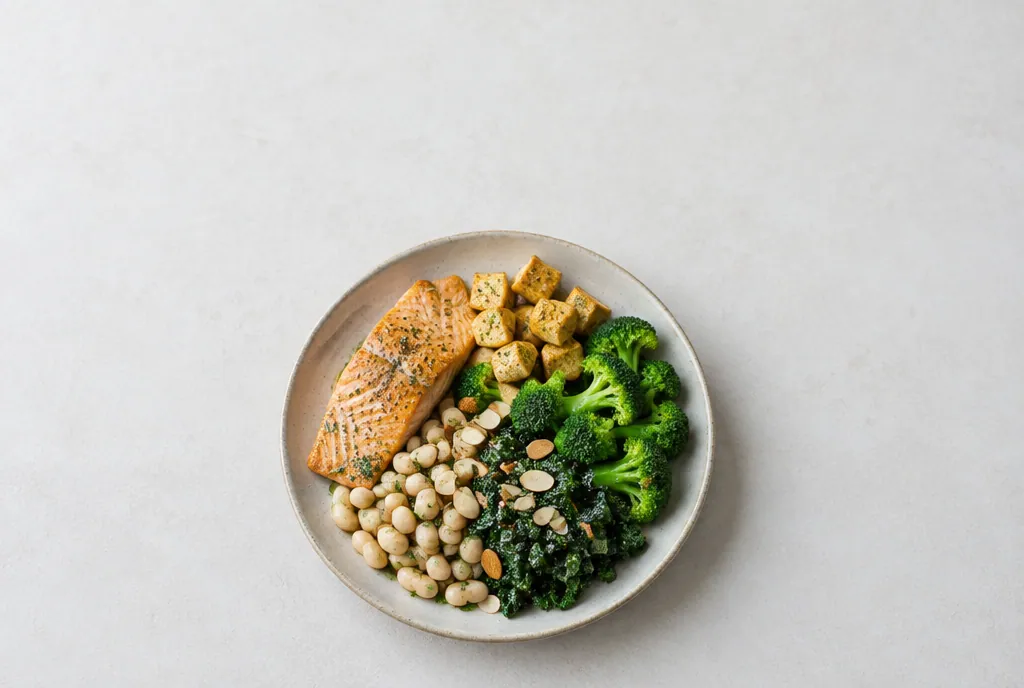
This plate also works if you simply want less dairy. On The Better Plate, several foods can cover calcium and protein:
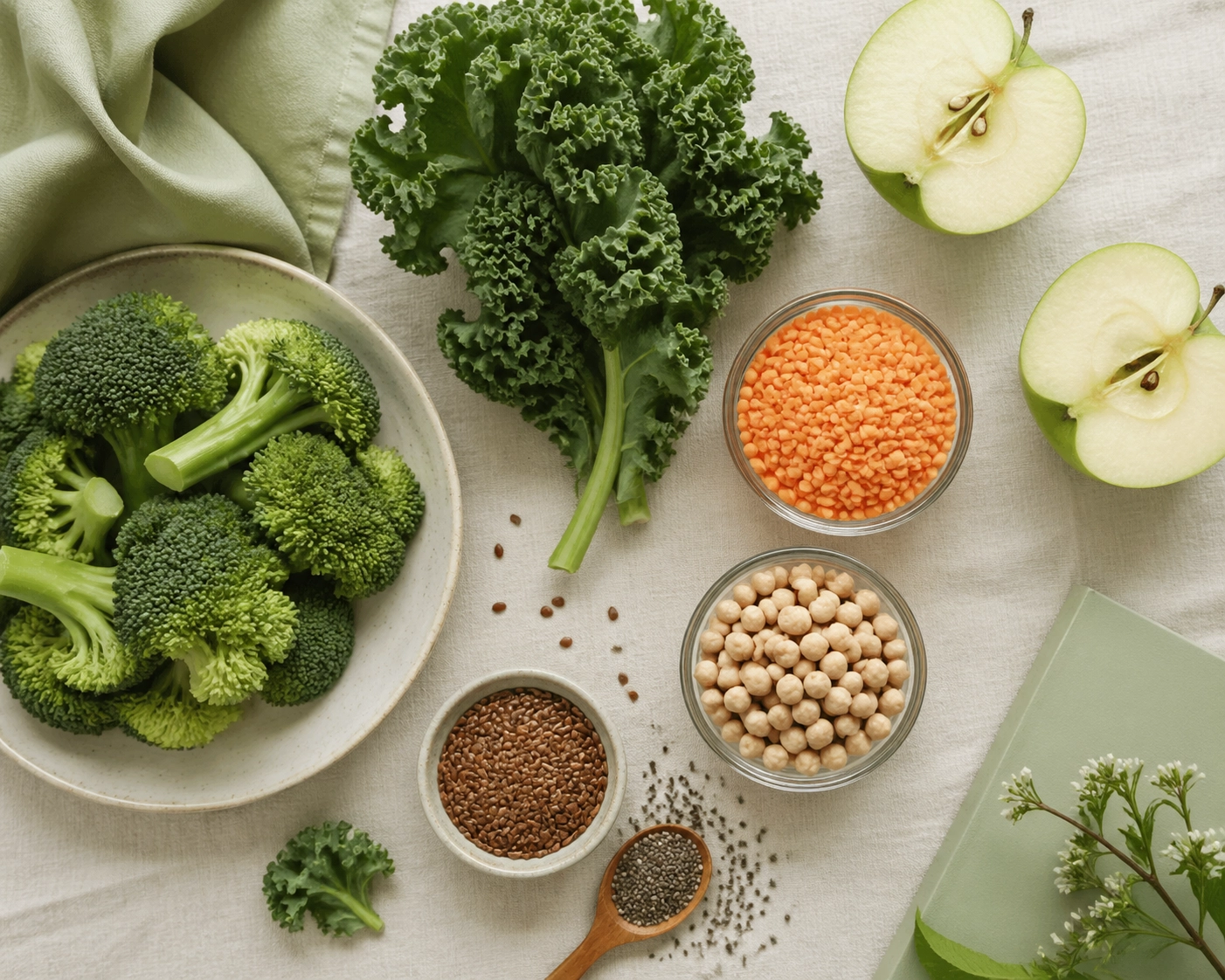
- calcium: sardines and tinned salmon with soft bones, tofu, broccoli and leafy greens, beans, almonds;
- vitamin D: oily fish and eggs, and if in doubt, a blood test and a talk with your doctor about a supplement;
- protein: fish, eggs, legumes, tofu;
- live cultures: sauerkraut, kimchi, miso.
Plant "milks" are worth a look at the label. Soy comes closest on protein: about 7 g a cup against 8 g in cow's milk. Almond usually has about 1 g. Calcium and vitamin D are added to roughly 70% of these drinks, and the calcium may be less well absorbed because of phytates and oxalates. I would pick unsweetened soy with added calcium, and I wouldn't count oat drink as a protein replacement.
Fat-free, low-fat, high-protein: what to choose
Science hasn't shown that low-fat yogurt itself does harm. If you like 1.5% and it has no sugar, there is nothing to change. But fat-free no longer looks mandatory either.
- Fat. A small controlled study of 30 people compared saturated fat from 4% yogurt with low-fat yogurt plus butter. Apolipoprotein B, a marker of vascular risk, rose only on the butter version. The study was short, but it hints that the source of the fat matters.
- Ingredients. Without fat, yogurt is thinner, so producers often add thickeners, and sweetened versions get sugar or sweeteners. Clean low-fat products exist as well, so read the list: it should say milk and cultures. The data on harm from sweeteners are so far only observational.
- Vitamins. Some vitamin A and D goes with the fat. Sometimes they are added back.
- Fullness. Many people stay full longer after 3–5% yogurt, but that is a practical observation: I found no solid research on yogurt fat and fullness specifically.
High-protein products can be useful. In a small study of 15 women, those who had a yogurt with 24 g of protein asked for dinner 26 minutes later than after one with 5 g of protein and the same calories. If you struggle to get enough protein at breakfast, they are convenient. But skyr, Greek yogurt and cottage cheese give you protein without a long ingredient list. A protein dessert with syrup is, to me, a dessert.

This is how I choose:
- whichever fat level tastes good, usually 2–5%, unless your doctor has said otherwise;
- cheese in a small portion, for flavour;
- with high LDL cholesterol, a talk with the doctor about fat;
- yogurt with no sugar in the ingredients, and I add fruit and nuts myself.
What you can do this week 🌱
Start with one change:
- turn your yogurt pot around and read the ingredients;
- swap sweetened yogurt for plain with berries;
- if your stomach bothers you, keep a diary for two weeks;
- if you don't eat dairy, count where today's calcium came from.
If you love cheese and it suits you, enjoy it without guilt. And if your stomach says no, you have a test, lactose-free products and plenty of other good food 💚
Frequently asked questions
Does milk cause inflammation? The studies I reviewed don't conclude that. In the yogurt comparison, inflammatory markers didn't differ between the options. If dairy makes you feel unwell, it is worth discussing with a doctor.
Can I eat cheese every day? If it suits you, yes. Lower cardiovascular mortality is linked with as little as a 15 g slice, and the dementia data with 50 g or more, but cause and effect aren't proven. Cheese is salty and calorie-dense, so portions matter.
Can intolerance appear after 40? Yes. Lactase can decline over time, but new symptoms can have other causes too, so it is better to check.
Is kefir fine if I'm intolerant? Often yes, especially in small portions. It has less lactose than milk, but it does contain some. Go by how you feel.
Is lactose-free milk worse than regular? I found no data showing that. It tastes sweeter because the lactose is already split into glucose and galactose.
Do I need a test if I have no symptoms? Usually not. A genetic variant without symptoms doesn't require any change in how you eat.
Want to see how this looks on a plate? Open the free trial day with three TheBetterPlate recipes. All my materials are here.
Get new Better With Anna articles straight to your inbox.
Sources: Du Y. et al., Neurology, 2026, doi.org/10.1212/WNL.0000000000214343. Dairy and mortality, Frontiers in Nutrition, 2026, doi.org/10.3389/fnut.2026.1731841. Fermented foods and mortality, Frontiers in Nutrition, 2026, doi.org/10.3389/fnut.2026.1714437. Zhang F., Li W., Scientific Reports, 2026, doi.org/10.1038/s41598-026-71687-9. Evershed R. et al., Nature, 2022, doi.org/10.1038/s41586-022-05010-7. Review of lactose and probiotics, Antonie van Leeuwenhoek, 2026, doi.org/10.1007/s10482-026-02278-x. Lactose knowledge survey, European Journal of Nutrition, 2026, doi.org/10.1007/s00394-026-04106-4. Yogurt and butter, European Journal of Nutrition, 2024, doi.org/10.1007/s00394-024-03352-8. Protein yogurt, Appetite, 2013, doi.org/10.1016/j.appet.2012.09.012. NIDDK on lactose intolerance. Retraction notice for the 2017 paper00398-4/fulltext).
The information on this site is for educational purposes only and does not replace medical advice. Before changing your diet or starting any health-related programme, consult a professional, especially if you have a chronic condition, are pregnant or breastfeeding, or take medication.