Ozempic and weight: what happens after the last injection — and what lasts
GLP-1 medications help people lose weight — but what happens once they stop? A calm look at the latest research (STEP 1, SURMOUNT-4, the 2026 BMJ meta-analysis, data on 157,822 people in Denmark) and why habits matter so much for long-term results — with charts and sources.
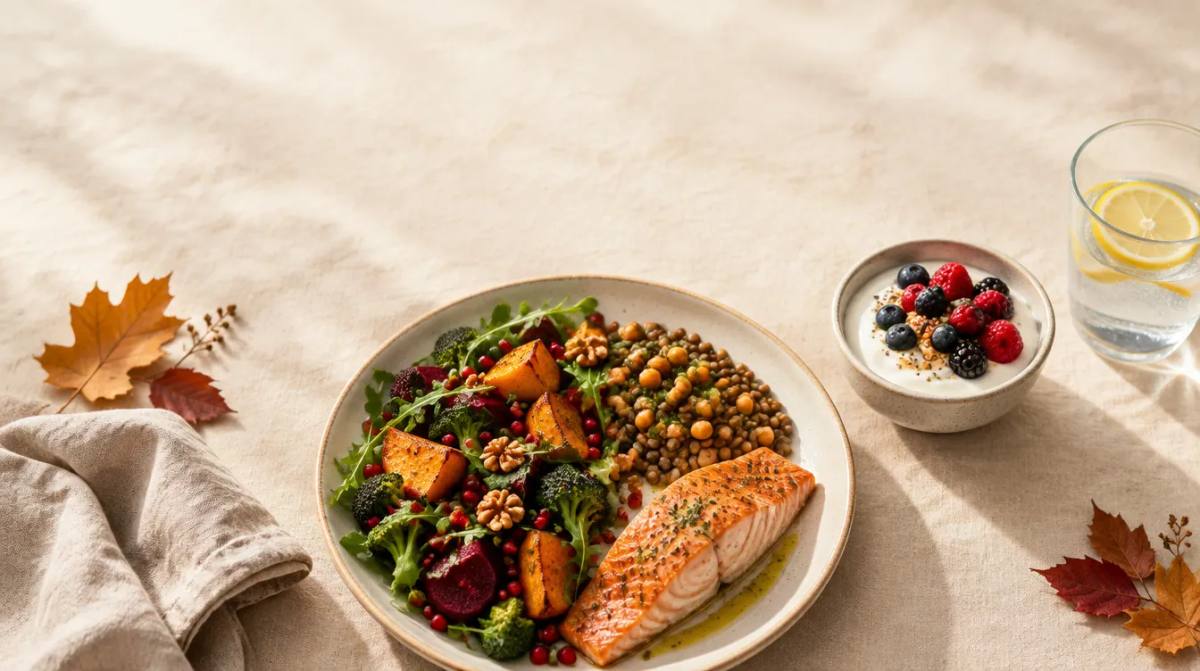
A friend (a composite — I hear stories like this all the time) tells you over coffee: "I've been on the injections for six months — twelve kilos down. I barely have an appetite, I forget to eat." You look at her and think: maybe I should too? After all, how many attempts have there been — Mondays, challenges, "no sugar starting tomorrow".
A year later you meet her again. She has stopped the injections: too expensive, the nausea, and "how long can you keep doing this". And quietly, almost apologetically, she says: "You know, the weight is coming back. And fast."
I hear both versions of this story more and more often. So today I want to look calmly, without scaremongering, at what the latest research actually shows about GLP-1 medications — semaglutide (Wegovy® for obesity, Ozempic® for type 2 diabetes) and tirzepatide (Mounjaro®). Especially at the part social media rarely talks about: what happens after the last injection. 🔬
What GLP-1 is — and why it isn't "magic"
GLP-1 (glucagon-like peptide-1) is not an invention of the pharmaceutical industry. It is your own satiety hormone. Special L-cells in your gut release it when you eat: it tells your brain "that's enough", slows the emptying of your stomach, boosts insulin release when blood sugar rises and holds back glucagon.
Your own GLP-1 lasts only a few minutes in the blood. The medications mimic its action but stay in the body far longer — the injectable forms of semaglutide and tirzepatide are given once a week (tirzepatide also activates the receptors of a second hormone, GIP). That is where the effect comes from: appetite becomes noticeably quieter, the "food noise" in the head fades for many people, and portions shrink by themselves.
These are serious medicines with proven effects — doctors prescribe them for type 2 diabetes and obesity, and they genuinely help many people. The question I want to explore is a different one: what remains once people stop taking them?
What the research shows after stopping
📊 STEP 1: two thirds of the weight — within a year
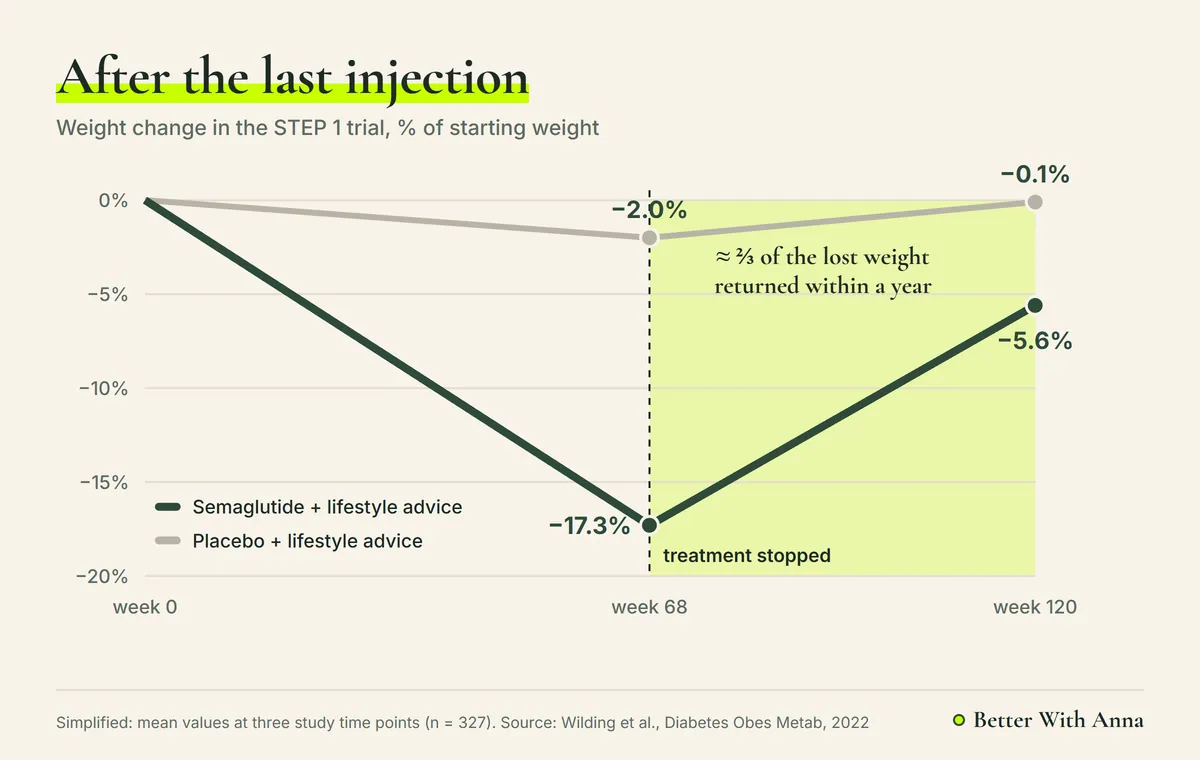
In the STEP 1 trial, participants took semaglutide 2.4 mg for 68 weeks alongside a lifestyle programme and lost an average of 17.3% of their body weight. An impressive result.
Then treatment was stopped — both the medication and the lifestyle programme — and 327 participants were followed for another year (228 from the semaglutide group and 99 from the placebo group). Over that year, the semaglutide group regained an average of 11.6 percentage points — about two thirds of the weight they had lost. The result at 120 weeks: −5.6% from the start. Blood pressure, blood sugar and cholesterol, which had improved on the medication, returned to or close to baseline for most measures (Wilding et al., Diabetes, Obesity and Metabolism, 2022).
📊 SURMOUNT-4: +14% in the year after stopping
The picture with tirzepatide is similar. In the SURMOUNT-4 trial, participants lost an average of 20.9% of their weight over 36 weeks on the medication. Half of them were then switched to placebo — and over the following year they regained +14% (Aronne et al., JAMA, 2024).
📊 BMJ meta-analysis 2026: faster regain than after diet programmes
The newest and arguably most important data were published in January 2026. Researchers at the University of Oxford pooled 37 studies with data from 9,341 people (West et al., BMJ, 2026):
- after stopping weight-loss medication, weight returned at an average of 0.4 kg per month — this covers all medications, including older ones; for semaglutide and tirzepatide it was about 0.8 kg per month;
- according to the authors' model, all the lost weight is projected to return in about 1.7 years (about 1.5 years for semaglutide and tirzepatide);
- improvements in blood pressure, cholesterol and blood sugar are projected to disappear within about 1.4 years;
- after medication, weight came back 0.3 kg per month faster (0.4 vs 0.1 kg) than after the end of programmes built on diet and physical activity — regardless of how much weight had been lost. This is an indirect comparison with data on such programmes; the BMJ press release describes it as "almost four times faster".
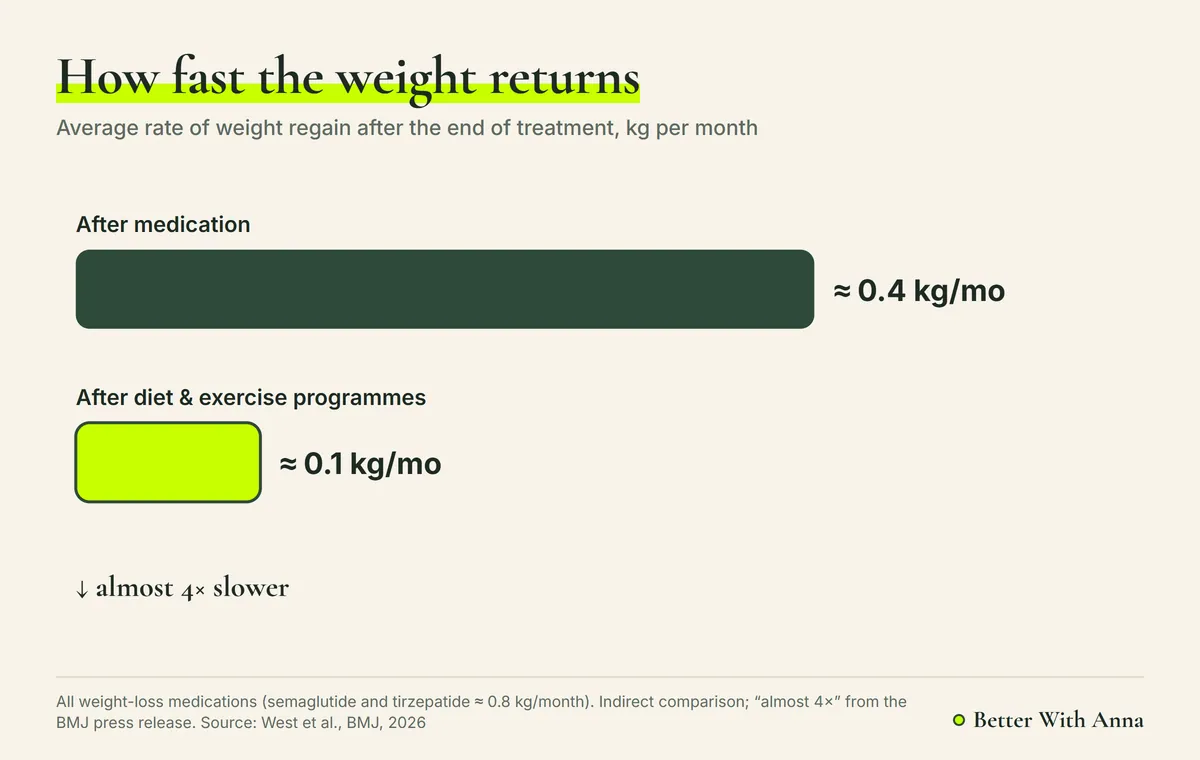
The researchers draw a very measured conclusion: short-term use of these medications without a more comprehensive approach to weight management should be considered with caution.
Real life: many stop within the first year
In clinical trials, people take the medication exactly as prescribed. Real life is different.
In August 2026, Danish researchers published data on everyone in Denmark who started semaglutide for weight loss for the first time between December 2022 and November 2024 — 157,822 people (Mailhac et al., JAMA Network Open, 2026). After 3 months, 13% had stopped; after six months, 27%; after 9 months, 39%; and after a year, 49% — almost every second person. About one in four of those who stopped restarted within three months. Based on the characteristics of those who stopped, the authors suggest cost (treatment is not reimbursed in Denmark and costs around €2,200–3,700 a year) and gastrointestinal side effects played a role.
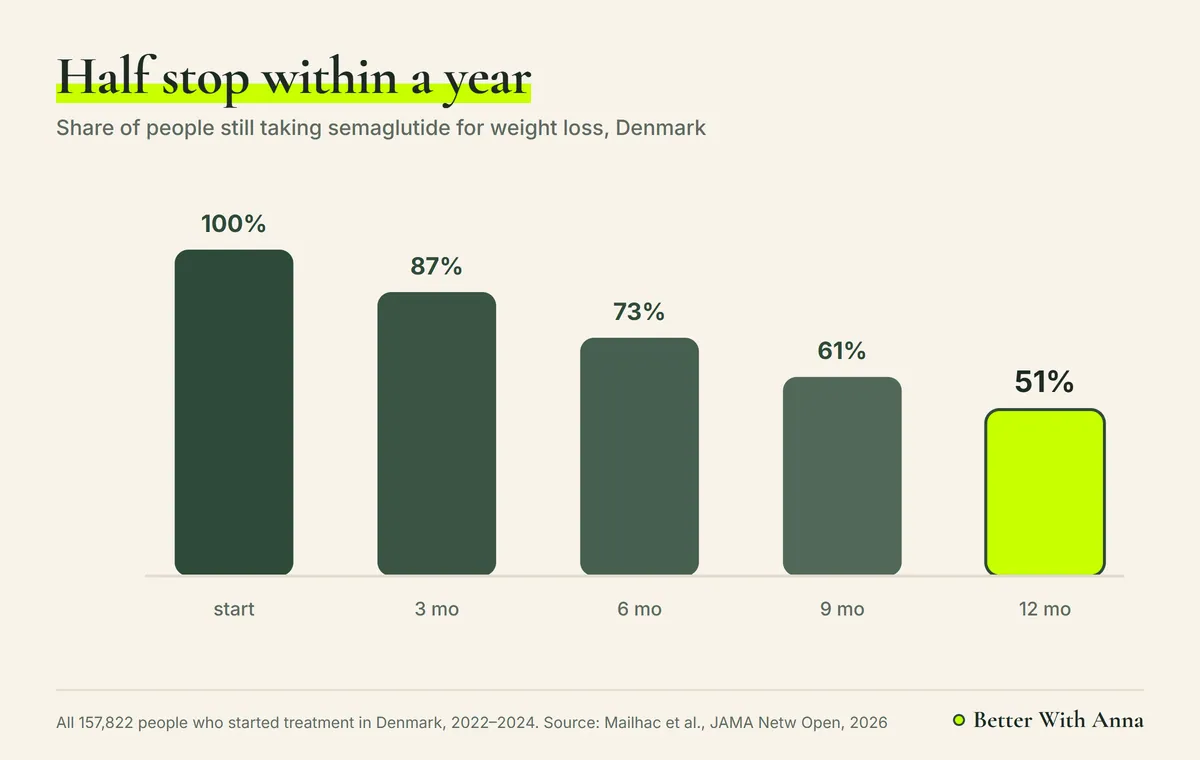
Put these findings side by side — many people stop treatment within the first year, and in studies the weight usually returns after stopping — and it becomes clear why the question that matters to me is not "how fast can I lose weight" but "what will be left in two years".
What the scales don't show
There are two more things worth knowing.
🥩 1\. Eating less doesn't mean eating better
When you barely have an appetite, it is easy to eat "just something" — and too little. In a small study presented at the European Congress on Obesity in 2026 (116 GLP-1 users, data from an Italian app), people on the medication logged around 1,100 kcal a day in the app (non-users around 1,280; apps like this usually underestimate real intake). They skipped meals more often, and almost 88% did not reach the recommended protein intake (Vinelli, ECO 2026). The study is small, but it illustrates the trend well.
💪 2\. Some lean mass goes along with the fat
With any rapid weight loss, you lose not only fat but also part of your lean mass — including muscle. Scientists are still studying how much this affects strength and health: according to reviews, the loss is proportional to the amount of weight lost, and data for older people are still mixed (Mollero et al., Nutrients, 2026). But for us women over 40, muscle isn't about looks. It is the main site where glucose is cleared after a meal, the support for our bones and the key to an active life at 60 and 80. I wrote about this in detail in my article on protein without extremes.
It is no coincidence that four American professional organisations — in lifestyle medicine, nutrition and obesity — issued joint recommendations in 2025. Among the main challenges of treatment they explicitly name nutrient deficiencies, loss of muscle and bone mass, low long-term adherence and subsequent weight regain (Mozaffarian et al., Joint Advisory ACLM, ASN, OMA, TOS, 2025).
So what lasts? The evidence on habits
This is the part I really wrote this article for. 🌱
🏃♀️ The Copenhagen study: what remains a year later
Danish researchers ran a very telling experiment (Jensen et al., eClinicalMedicine, 2024). Adults with obesity first lost an average of 13.1 kg on a diet. They then spent a year maintaining the result in one of four ways: medication only (liraglutide — an earlier-generation GLP-1 medication), regular exercise only, the combination, or placebo. And then — a year with no support at all.
Weight regained in the year after the programme ended:
- after medication only: an average of 9.6 kg;
- after medication plus exercise: 7.1 kg;
- after exercise only: 3.6 kg;
- in the exercise group, body weight and body composition were, by the authors' assessment, largely maintained.
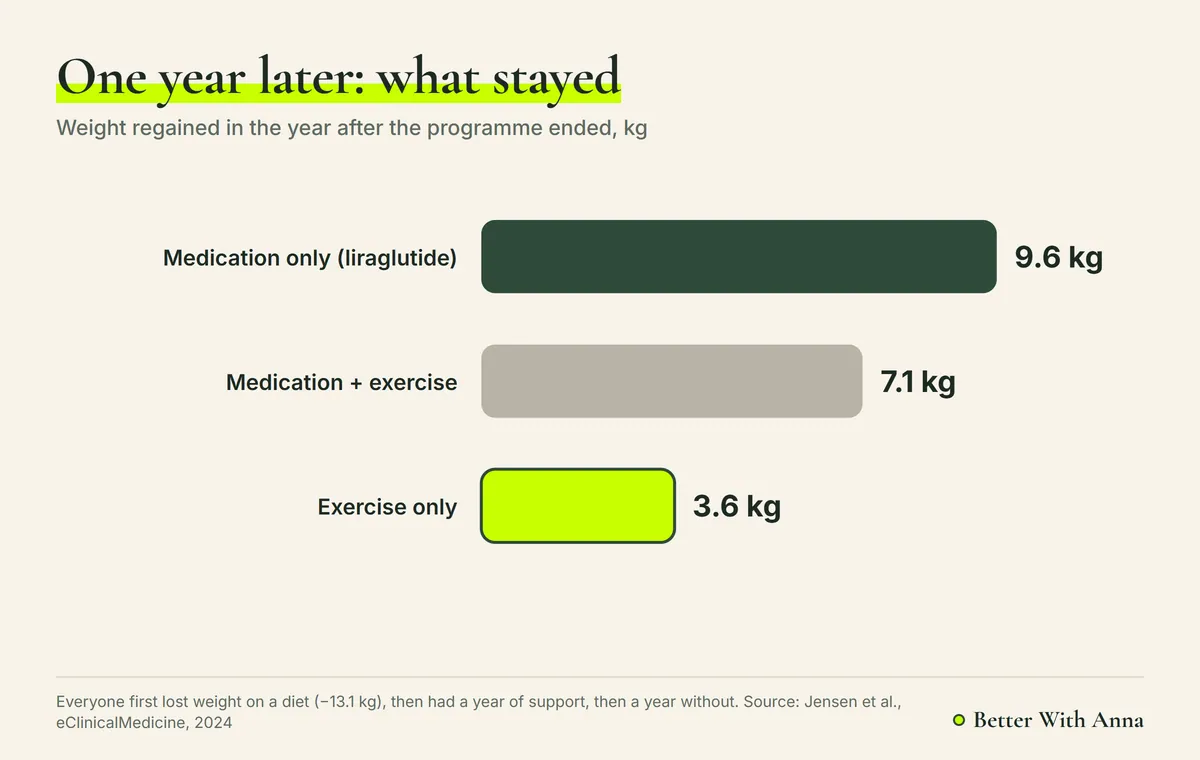
A year after the programme ended, former members of the exercise groups were still clearly more active: a median of 240 minutes of moderate-to-vigorous activity a week, compared with 30 in the medication-only group. The authors note that physical activity is a behaviour people can continue without a programme. The study is small — 109 people attended the final visit. But the picture is very clear: the medication stopped working, and what people had learned stayed.
🧬 The Diabetes Prevention Program: the effect after 15 years
This is perhaps the strongest evidence that the effect of lifestyle change can last a decade and a half. In the US Diabetes Prevention Program (DPP), people at high risk of diabetes learned to eat differently and move more. Over 15 years of follow-up (2,776 participants), the rate of diabetes in the lifestyle group was 27% lower than in the former placebo group, although the difference narrowed over time (Lancet Diabetes & Endocrinology, 2015). This is specifically about preventing diabetes, not about weight.
Let's be honest: after diet programmes, some weight can come back too — no method comes with guarantees. But according to the same BMJ meta-analysis, it comes back noticeably more slowly. And most importantly, knowledge and skills don't disappear: you know how to build a plate, what to buy, how to eat at a friend's house. None of that needs to be "renewed" every week.
Your own GLP-1: what nutrition can influence
Your body can produce GLP-1 itself — and nutrition can influence that. Let me be honest straight away: the effect of food is much more modest than that of the medication, as the authors of the reviews state plainly (Tkaczenko et al., Nutrients, 2026), and the evidence so far is mainly mechanistic or from small studies. But nutrition is available every day — and with it you build something that stays with you for years.

🥦 1\. Fibre that "feeds" your bacteria
Fermentable fibre — legumes, oats, barley, cooled potatoes and rice, onions, Jerusalem artichoke, berries — becomes food for your beneficial gut bacteria. They produce short-chain fatty acids, which can stimulate L-cells to release GLP-1. More in my article on fibre.
🍳 2\. Enough protein
Protein is involved in the release of satiety hormones, including GLP-1, and protects your muscles. For periods of weight loss, experts suggest a target of around 1.2–1.6 g of protein per kilogram of body weight per day (Joint Advisory, 2025) — easiest when spread across all your meals.
🥗 3\. The order on your plate
Vegetables and protein first, starchy foods last. In a small study in people with type 2 diabetes, this order not only reduced the blood sugar spike but also raised GLP-1 levels after the meal (Shukla et al., BMJ Open Diabetes Research & Care, 2017). More in my article on insulin resistance.
🫙 4\. Fermented foods
Kefir, natural yogurt, sauerkraut — according to reviews, they may also play a part in regulating GLP-1 through the microbiome.
💪 5\. Sleep and strength training
In a small classic study, just two nights of short sleep lowered the satiety hormone leptin by 18% and raised the hunger hormone ghrelin by 28% (Spiegel et al., Annals of Internal Medicine, 2004). And strength training protects your muscles — the very "engine" that clears glucose after a meal.
The Better Plate: a system instead of willpower
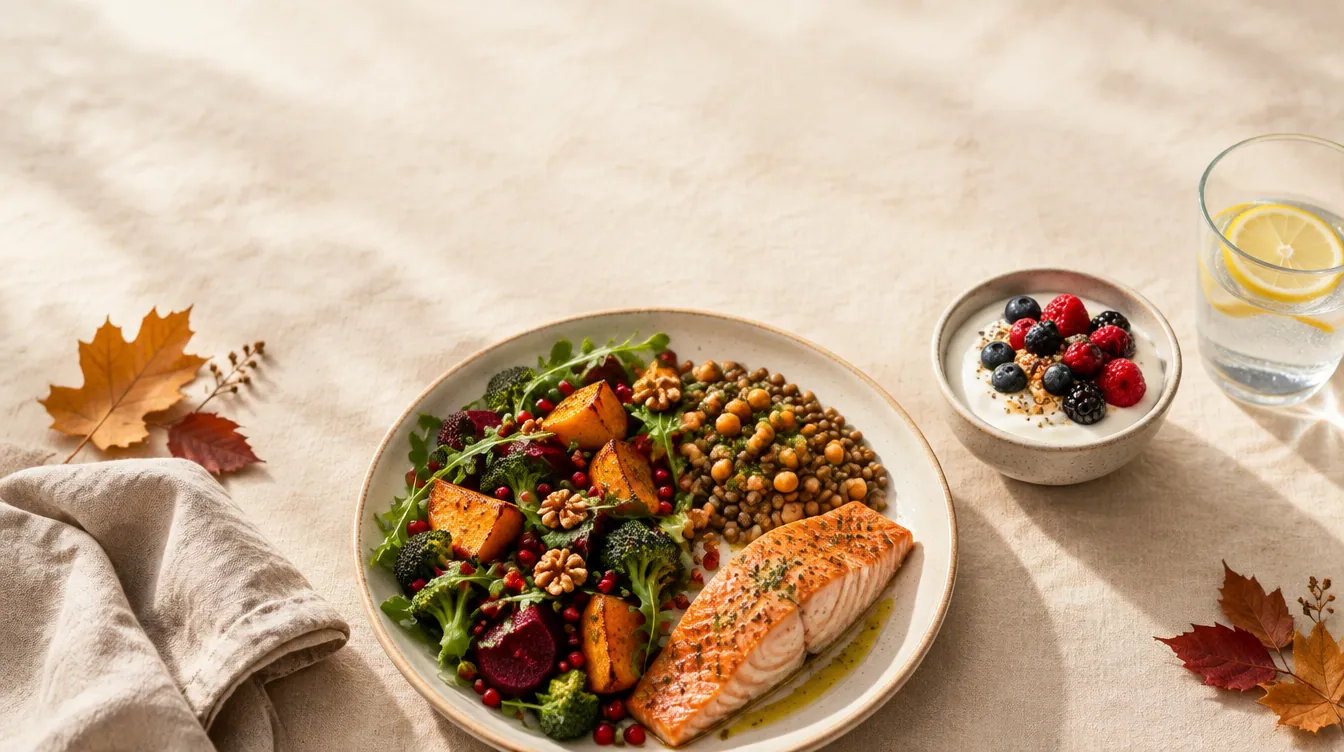
That is why in The Better Plate we don't count calories or ban foods. We build a plate that supports satiety: half vegetables and fibre, a quarter quality protein, a quarter slow carbohydrates, plus healthy fats. The method is inspired by the Harvard Healthy Eating Plate and enriched with longevity research.
A plate like this helps you support a natural feeling of fullness day after day and build habits that stay with you. It is not a replacement for medication if it has been prescribed for you — it is the foundation you need either way.
Start with one change this week:
- ✅ Add a handful of legumes to one lunch — lentils in a soup, chickpeas in a salad.
- ✅ Start dinner with a plate of vegetables.
- ✅ Check your breakfast: does it include protein — eggs, cottage cheese, yogurt, legumes?
- ✅ Add two strength sessions a week — even 20 minutes at home.
- ✅ Go to bed 30 minutes earlier.
The most important thing
I am not against medication — when a doctor prescribes it for a medical reason, that is a decision between doctor and patient, and it deserves respect. But if you are currently thinking about injections for weight loss and dream of a result that will still be with you in two, five, ten years, remember what the research shows: after stopping the medication, weight returns faster than after diet and exercise programmes — and habits are what stay with you regardless of treatment.
This isn't about willpower or punishment. It's about a system that gradually becomes your own. In small steps. 💚
And I'll be right here to support you.
Educational note: this article is for information only, is based on published scientific research and is not medical advice. Do not stop or start any treatment without your doctor. Decisions about prescribing, continuing or stopping any medication are made only together with your doctor. Before changing your diet, starting FMD or any health-related programme, please consult a professional — especially if you have diabetes or a chronic condition, are pregnant or breastfeeding, or take medication. Ozempic® and Wegovy® are registered trademarks of Novo Nordisk, Mounjaro® of Eli Lilly and Company; Better With Anna is not affiliated with the manufacturers and receives no funding from them. The Better Plate is inspired by the Harvard Healthy Eating Plate; Better With Anna is not affiliated with Harvard University.
Frequently asked questions
Why does the weight so often come back after stopping? The medication strengthens the satiety signal while it is working; once it is stopped, appetite returns to its previous level. The authors of the BMJ meta-analysis suggest that on the medication, weight drops without a conscious change in eating habits, so practical skills may be missing after stopping. In STEP 1 and SURMOUNT-4, between half and two thirds of the lost weight returned within a year of stopping, and for semaglutide and tirzepatide the average rate of regain in the meta-analysis was about 0.8 kg per month.
Can food influence my own GLP-1? Partly, yes — although the effect is much more modest than that of the medication. Fermentable fibre (legumes, oats, cooled potatoes and rice), enough protein and fermented foods may influence natural GLP-1 production, according to reviews (based mainly on mechanistic and small studies).
What happens to muscle with rapid weight loss? With any rapid weight loss, you lose not only fat but also some lean mass. That is why enough protein and strength training matter so much — professional organisations in nutrition and obesity emphasise them too.
I'm thinking about injections for weight loss. Where do I start if I want a long-term result? Nutrition, protein, fibre, sleep and movement are the foundation either way, with or without medication. Discuss the question of medication with your doctor: only they can assess whether it is indicated for you.
I'm already taking the medication. What should I do? Please don't change your treatment on your own — any change only with your doctor. Talk to them about how to keep your protein intake and muscles up. Important: FMD and programmes with significant calorie restriction, including Total Reset, are not designed to be done while taking GLP-1 medications.
About my programme
Would you like to build a way of eating that stays with you for the long term? That's why I created Total Reset — 3 weeks: one FMD week (5 days of fasting-mimicking nutrition), followed by two weeks in which you learn The Better Plate method step by step: the plate, protein, fibre, sleep, the order of eating. The programme includes a protein ebook and the "Healthy Gut" ebook — so the knowledge stays with you after it ends. Based on the experience of more than 500 participants in my programmes, the average result over 3 weeks was between 3 and 7 kg — but this is not a promise: every woman's result is her own and depends on her starting point. What stays is the habits. 🌱
The programme is not designed to be done while taking GLP-1 medications and does not replace treatment prescribed by a doctor. FMD has contraindications — they are listed on the programme page.
Read also: Insulin resistance: why "normal blood sugar" doesn't mean everything is fine · Protein without extremes · Fibre — not just about digestion
Get new Better With Anna articles straight to your inbox — calm, to the point and spam-free.
Warmly, Anna Bertoldi
Sources
- Wilding JPH et al. Weight regain and cardiometabolic effects after withdrawal of semaglutide: the STEP 1 trial extension. Diabetes Obes Metab. 2022. doi:10.1111/dom.14725
- Aronne LJ et al. Continued treatment with tirzepatide for maintenance of weight reduction in adults with obesity: the SURMOUNT-4 randomized clinical trial. JAMA. 2024. doi:10.1001/jama.2023.24945
- West S et al. Weight regain after cessation of medication for weight management: systematic review and meta-analysis. BMJ. 2026;392:e085304. doi:10.1136/bmj-2025-085304 · press releases: BMJ, University of Oxford
- Mailhac A et al. Discontinuation of semaglutide therapy for obesity management. JAMA Netw Open. 2026. doi:10.1001/jamanetworkopen.2026.31371
- Jensen SBK et al. Healthy weight loss maintenance with exercise, GLP-1 receptor agonist, or both combined followed by one year without treatment. eClinicalMedicine. 2024. doi:10.1016/j.eclinm.2024.102475
- Diabetes Prevention Program Research Group. Long-term effects of lifestyle intervention or metformin on diabetes development and microvascular complications over 15-year follow-up. Lancet Diabetes Endocrinol. 2015. doi:10.1016/S2213-8587(15)00291-0
- Tkaczenko H et al. Foods as modulators of GLP-1 secretion. Nutrients. 2026. doi:10.3390/nu18182995
- Mollero ELM et al. Beyond weight loss: skeletal muscle health during incretin-based therapy in patients with diabesity. Nutrients. 2026. doi:10.3390/nu18162654
- Mozaffarian D et al. Nutritional priorities to support GLP-1 therapy for obesity: a joint advisory from ACLM, ASN, OMA and TOS. Am J Clin Nutr. 2025;122:344–367. doi:10.1016/j.ajcnut.2025.04.023
- Vinelli V. Dietary intake in GLP-1 users. European Congress on Obesity, 2026 (abstract). Healio
- Shukla AP et al. Carbohydrate-last meal pattern lowers postprandial glucose and insulin excursions in type 2 diabetes. BMJ Open Diabetes Res Care. 2017. doi:10.1136/bmjdrc-2017-000440
- Spiegel K et al. Brief communication: sleep curtailment in healthy young men is associated with decreased leptin levels, elevated ghrelin levels, and increased hunger and appetite. Ann Intern Med. 2004. doi:10.7326/0003-4819-141-11-200412070-00008